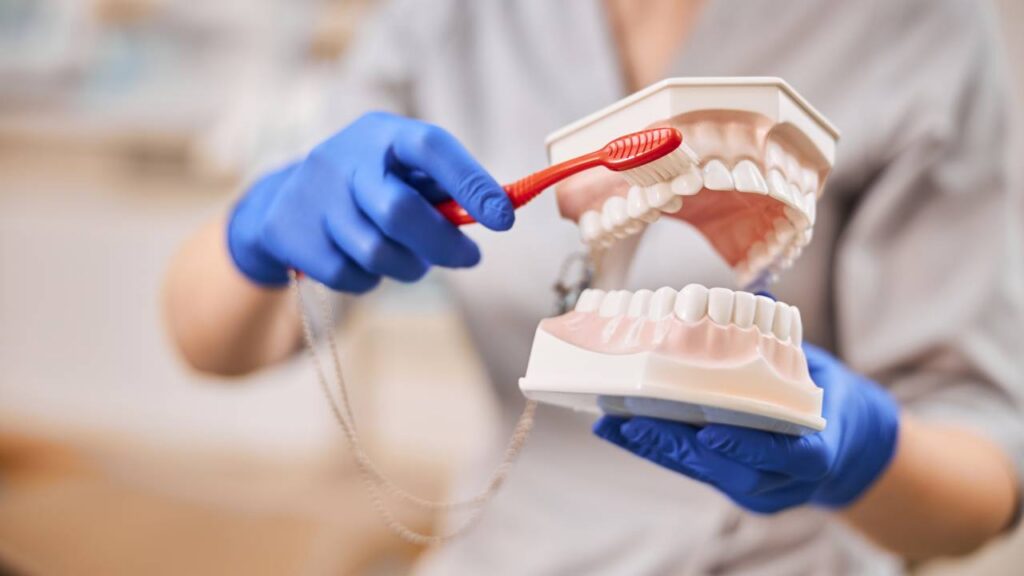
About half of American adults have some form of gum disease, according to the CDC, yet most of them had no idea anything was wrong until a dentist pointed it out. Understanding the stages of gum disease explained in plain terms is the fastest way to turn that statistic from alarming to actionable.
What to Expect in This Guide
- What gum disease is and why it progresses the way it does
- The four clinical stages and what each one means for your teeth
- How dentists diagnose which stage you’re in
- The connection between gum disease and your overall health
- Treatment options matched to each stage
- Risk factors that speed up progression
- Daily habits and professional care that keep it from advancing
What Gum Disease Actually Is (and Why It Progresses the Way It Does)
The CDC estimates that 47.2% of U.S. adults aged 30 and older have some form of periodontal disease, with that number climbing to 70.1% among adults 65 and older. For a condition that starts silently, those numbers reflect just how easy it is to miss.
Periodontal disease is a bacterial infection of the structures supporting your teeth: the gums, the periodontal ligament, and the underlying jawbone. It begins when plaque, the soft film of bacteria that forms on teeth daily, is not fully removed by brushing and flossing. Within 24 to 72 hours, plaque that sits undisturbed begins to harden into tartar, a calcified deposit that ordinary brushing cannot remove. The tartar provides a protected surface where bacteria multiply and release toxins directly into the gum tissue.
Your immune system responds to that bacterial invasion, and this is where the damage compounds. The inflammatory response meant to fight the infection also breaks down the very tissue and bone it is trying to protect. Over time, that cycle of bacterial attack and immune response erodes the structures holding your teeth in place. The earlier that cycle is interrupted, the less structural damage occurs. That is why stage matters so much: catching this in its first stage looks almost nothing like managing it in its fourth.
The Four Stages of Gum Disease, Explained
The American Academy of Periodontology (AAP), in collaboration with the European Federation of Periodontology, released a landmark classification system in 2017 that replaced older, less precise staging models. Under this framework, periodontal disease is assigned a stage from 1 to 4, based on the severity of bone loss, pocket depth, tooth mobility, and tooth loss. A companion grading system (A, B, or C) accounts for how quickly the disease is progressing in your specific case.
Stage determines treatment, not just severity. Stages 1 and 2 can be arrested and, in the case of gingivitis, fully reversed. Stages 3 and 4 require more aggressive intervention and leave lasting structural changes that do not spontaneously regenerate. Knowing which stage you are in is the difference between a professional cleaning and a surgical consultation.
Stage 1: Gingivitis: The Only Stage That’s Fully Reversible
Gingivitis is inflammation of the gum tissue caused by plaque accumulation. At this stage, the infection has not yet reached the bone or the deeper connective tissue. That distinction is what makes gingivitis the one stage where complete reversal is possible with treatment and consistent home care.
The warning signs are easy to dismiss. Gums that bleed when you brush or floss, tissue that looks puffy or darker red than usual, and mild persistent bad breath are the hallmarks. A 2022 survey published in the Journal of Dental Hygiene found that more than 40% of patients reported bleeding gums but assumed it was normal or caused by brushing too hard. It is not normal. Healthy gum tissue does not bleed in response to gentle brushing.
The practical step at this stage is immediate and straightforward. If you notice any of these early signs of gum disease, schedule a professional cleaning and ask your dental provider to evaluate your gum health specifically, not just your teeth. Combined with twice-daily brushing and daily flossing, most patients see complete resolution within a few weeks.
Stage 2: Early Periodontitis: When Bone Loss Begins
The transition from gingivitis to periodontitis happens when bacteria penetrate below the gumline and the body’s immune response begins destroying the supporting bone. This shift is not visible in a mirror, which is why many patients with early periodontitis still believe their gum health is fine.
At Stage 2, pocket depths typically measure between 4 and 5 millimeters. Those pockets are spaces between the tooth and the gum that have deepened as tissue detaches and pulls away. Increased bleeding, early gum recession, and sensitivity to temperature or pressure are common at this point. A 2020 study in the Journal of Clinical Periodontology found that without treatment, patients with early periodontitis lost an average of 0.5 to 1 mm of bone per year, a rate that accelerates if underlying risk factors like smoking or diabetes are present.
The standard first-line treatment here is scaling and root planing, a deep-cleaning procedure that removes calculus below the gumline and smooths root surfaces so bacteria cannot reattach easily. For a detailed walkthrough of what that procedure involves, the process is more straightforward than most patients expect, and local anesthesia keeps it comfortable.
Stage 3: Moderate Periodontitis: Structural Damage You Can’t Ignore
By Stage 3, the damage is measurable and visible on X-rays. Pocket depths at this stage fall between 6 and 7 millimeters, bone loss is documented radiographically, and teeth may begin to shift position or feel slightly loose. Chronic bad breath that does not resolve with brushing is a consistent feature because the deep pockets harbor bacteria that no toothbrush can reach.
One finding that characterizes Stage 3 is furcation involvement. In plain terms, this means the bone loss has progressed to the area where the roots of a multi-rooted tooth diverge. Once bacteria and inflammation reach that zone, the tooth becomes significantly more difficult to clean and stabilize. Tooth loss at this stage moves from a theoretical risk to a concrete one.
A periodontist referral at Stage 3 is not optional, it is the appropriate next step. General dentistry has a role in getting patients to this point and maintaining them afterward, but the surgical and structural decisions required at Stage 3 fall within the scope of specialist care. Waiting costs bone that does not grow back without intervention.
Stage 4: Advanced Periodontitis: The Stage Where Teeth Are Lost
Stage 4 is characterized by pocket depths of 8 millimeters or more, significant bone loss throughout the jaw, and teeth that are visibly mobile or have already been lost. Chewing becomes difficult. The remaining teeth may drift, tilt, or develop bite problems as the supporting structures collapse around them.
The CDC links untreated periodontal disease directly to tooth loss, with severe periodontitis identified as one of the primary drivers of adult tooth loss in the United States. That is the worst-case outcome, but it is not the only outcome. Even at Stage 4, intervention preserves what remains. Saving the teeth and bone that are still viable, preventing further loss, and restoring function with implants or other prosthetics when necessary are all achievable goals. The complexity of treatment increases with stage, but so does the value of acting rather than waiting.
How Dentists Diagnose Which Stage You’re In
Diagnosis is more involved than a visual inspection. A full periodontal evaluation uses several tools together to establish your stage accurately.
Periodontal probing is the most direct measurement. A calibrated instrument is gently inserted into the space between each tooth and the surrounding gum tissue at six points per tooth. The depth of that space, measured in millimeters, tells the clinician how much attachment has been lost. Healthy pockets measure 1 to 3 mm. Numbers above that, combined with bleeding on probing, indicate active disease. What those measurements mean in practice is something worth understanding before your next exam, because the numbers in your chart tell a complete story about your gum health over time.
Dental X-rays add a second layer of information by showing the height of the bone surrounding each tooth root. Bone loss that is not yet clinically obvious often appears on radiographs first, which is why X-rays are a non-negotiable part of periodontal diagnosis. Visual examination of gum recession, tissue color, and tooth mobility rounds out the picture.
The 2017 AAP/EFP classification also assigns a grade (A, B, or C) alongside the stage. Grade A indicates slow progression with no significant risk factors. Grade B suggests moderate progression. Grade C reflects rapid progression, often linked to smoking, poorly controlled diabetes, or a documented history of rapid bone loss. Your grade informs how aggressively treatment is approached and how frequently you need follow-up care.
The Link Between Gum Disease and Your Overall Health
Periodontal bacteria do not stay confined to the mouth. The inflammation and bacterial burden generated by periodontal disease enter the bloodstream through the compromised gum tissue, and that systemic exposure has measurable consequences.
A 2021 study published in Cardiovascular Research, analyzing data from more than 1,000 patients, found that individuals with severe periodontitis had significantly elevated levels of C-reactive protein and interleukin-6, both markers of systemic inflammation linked to cardiovascular events. The connection between gum disease and heart disease is one of the more well-documented systemic links in oral medicine. Separately, the bidirectional relationship between periodontal disease and diabetes is equally established: uncontrolled blood sugar worsens gum disease, and untreated gum disease makes blood sugar harder to control. For patients already managing cardiovascular conditions or diabetes, understanding how periodontal inflammation affects blood sugar regulation is a direct motivation for treatment, not a distant concern.
Treating gum disease is not a cosmetic decision. For retirees managing multiple chronic conditions, or anyone with a family history of cardiovascular disease or diabetes, periodontal health is part of systemic health management.
Treatment Options at Every Stage
Treatment scales with stage severity. The goal at every stage is the same: stop bacterial infection, eliminate the conditions that let it persist, and preserve as much structure as possible.
Gingivitis Treatment: Professional Cleaning and Home Care Reset
A professional prophylaxis removes the tartar that home care cannot, and that single appointment can eliminate the bacterial load driving gingivitis entirely. After cleaning, consistent home care does the rest. Twice-daily brushing with a soft-bristle brush, daily interdental cleaning with floss or interdental brushes, and an antibacterial rinse when recommended by your provider are the standard protocol. For patients who want to accelerate healing, there are practical steps on reversing early gingivitis at home that complement professional treatment effectively.
Reversal at this stage is achievable within two to four weeks of consistent care following a professional cleaning. That timeline is not a promise, but it is the realistic expectation for patients without complicating factors.
Scaling and Root Planing for Early to Moderate Periodontitis
Scaling and root planing is a non-surgical deep-cleaning procedure performed under local anesthesia. Scaling removes the calculus deposits below the gumline that are fueling the infection. Root planing smooths the root surface, which reduces the surface area where bacteria can reattach and allows the gum tissue to heal and re-adhere more closely to the tooth.
A 2018 systematic review in the Journal of Periodontology, analyzing 72 clinical trials, found that scaling and root planing reduced average pocket depths by 1.1 to 2.2 mm in patients with moderate periodontitis, a clinically significant reduction that arrests progression and reduces infection load. Follow-up re-evaluation at six to eight weeks post-treatment confirms whether pockets have responded or whether additional intervention is needed. Skipping this step does not pause the disease: bone loss continues at whatever rate your grade and risk factors dictate.
The difference between treating gum disease non-surgically versus surgically often comes down to how early scaling and root planing is performed.
Advanced Treatment: Surgery, Bone Grafting, and Tooth Replacement
For Stages 3 and 4, surgical options address what deep cleaning cannot reach. Osseous surgery (pocket reduction surgery) reshapes the bone and reduces the pocket depth so that routine home care can maintain the result. Bone grafting uses graft material to restore lost bone volume, and guided tissue regeneration encourages the body to rebuild periodontal attachment in treated areas.
When teeth cannot be saved, implants or bridges restore function and prevent the bone resorption that follows tooth loss. Patients who have delayed care for years, a common pattern in adults who avoided the dentist during busy decades, consistently achieve stable, functional outcomes when they commit to a full treatment plan. The starting point is later, but the destination is the same.
Risk Factors That Accelerate Gum Disease Progression
Certain factors do not cause gum disease but dramatically increase the speed at which it advances. Smoking is the most documented: a large-scale analysis published in the Journal of Dental Research found that smokers are two to three times more likely to develop severe periodontitis than non-smokers, and that smoking suppresses the gum tissue’s ability to show classic inflammatory signs like bleeding. Smokers often appear less symptomatic while experiencing faster bone loss.
Uncontrolled diabetes, genetic predisposition, dry mouth caused by medications (a particularly relevant factor for older adults on multiple prescriptions), and chronic stress all contribute to faster progression. These factors do not exempt you from treatment. They make treatment more time-sensitive and maintenance more non-negotiable.
How to Stop Gum Disease From Progressing
The evidence-backed maintenance routine is not complicated, but it requires consistency. Brush twice daily with a soft-bristle brush for two full minutes. Clean between teeth every day: floss reaches the contact points that brushing misses, and interdental brushes are more effective in wider spaces or around implants. These two habits address the biofilm accumulation that drives every stage of the disease.
For patients who have been treated for periodontitis, professional maintenance visits every three to four months are the standard of care, not a suggestion. A 2019 study in the Journal of Clinical Periodontology, following 245 patients over five years, found that those who adhered to quarterly maintenance visits had a 50% lower rate of disease recurrence compared to patients who returned only annually. The mechanism is straightforward: pocket bacteria repopulate within 8 to 12 weeks, so quarterly visits stay ahead of that cycle.
For patients without active disease, a six-month recall is appropriate, but that interval should be re-evaluated any time your gum health changes.
Schedule a Periodontal Evaluation This Week
If you have not had a periodontal evaluation that includes pocket depth measurements, that is the specific appointment to request. Not a routine cleaning and exam, a periodontal evaluation where the hygienist or dentist probes and charts every tooth and reviews your bone levels on X-ray. Ask for “periodontal charting” by name when you call.
For patients in the Myrtle Beach, Surfside Beach, Murrells Inlet, and Grand Strand areas, Tidelands Dental provides periodontal evaluation and therapy as part of in-house general dental care. That means the same provider who diagnoses your gum disease manages your treatment, coordinates any referrals, and maintains your records over time. One practice, one relationship, one place to start. Call to schedule your periodontal evaluation, and bring your questions about what the numbers in your chart actually mean.